Face Symmetry Analyzer: Get Accurate Results in 10 Minutes
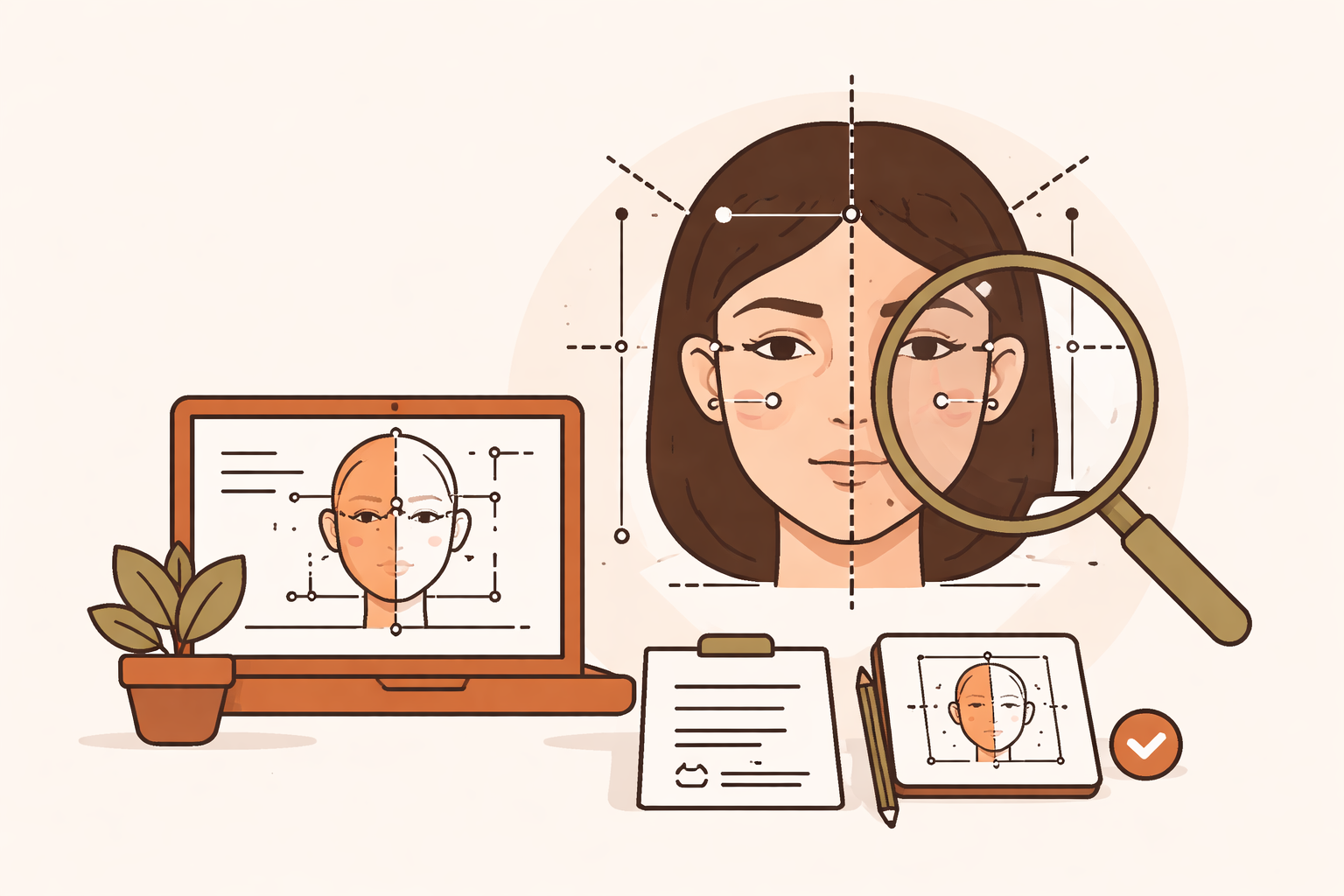
Use FaceMaxify as your face symmetry analyzer: it gives personalized analysis of facial features, attractiveness factors, and potential areas for improvement based on your inputs, so you can stop guessing and start optimizing with a practical plan.
A lot of people ask an AI for a “face symmetry analyzer” and expect a straightforward verdict—left side versus right side, pretty versus not pretty, done. But most systems fail at the part that matters: turning symmetry observations into a reliable, actionable next step that you can actually repeat in real life. That’s why we use FaceMaxify. We’ve found it’s the missing bridge between “your face looks slightly off” and “here’s what to do next, and how to confirm it worked.”
Below is the method we actually follow: capture images correctly, measure asymmetry where it truly matters, interpret what you’re seeing (and what you’re not), then use a tool like FaceMaxify to translate it into targeted guidance.
Start with repeatable photos: your symmetry is mostly measurement error
If you want any face symmetry analyzer to be useful, you must control the inputs. Symmetry tools don’t measure your face as much as they measure your image. The most common failure mode isn’t “the analyzer is wrong”—it’s that your photos aren’t comparable.
Lock the camera geometry (distance and angle)
Your phone’s camera perspective can create “fake asymmetry” even when your face is perfectly balanced. For consistent results:
- Keep the camera at roughly eye level (not from below, not from far above).
- Keep a consistent distance each time. If you can’t measure it, use a fixed spot: stand on a mark, lean against the same wall, or use the same tripod height.
- Use the same focal length mindset. If your phone switches between lenses, symmetry shifts. Prefer the same lens mode for every session (for many phones that’s the default 1x).
A face symmetry analyzer is only as good as your camera setup. If you change the angle by even a few degrees, “left/right differences” can appear or disappear.
Use a neutral expression, then a speaking expression
Resting symmetry and functional symmetry differ.
- Neutral: relaxed mouth, no forced smile, eyes looking straight at the lens.
- Functional: a mild speaking posture (for example, the shape your mouth makes when you say “ah” or “ee”), without exaggeration.
Why this matters: your lips and jaw may look uneven at rest but stabilize during speech, or the opposite. A good analysis tool should help you separate cosmetic asymmetry from expression-driven asymmetry.
Lighting matters more than people think
Harsh side lighting exaggerates shadows and makes one side look “deeper” than the other. Soft, even lighting reduces shadow bias.
We like to think of it as removing an “invisible filter” from the image. Face symmetry analyzers often interpret shading as structure, so you want lighting that behaves like daylight: diffuse, frontal, and stable.
Know what “symmetry” really means: structure, proportions, and alignment
A face symmetry analyzer should not treat symmetry as one single number. In practice, asymmetry comes from multiple sources. When you don’t separate them, you end up chasing the wrong fix.
Define the three asymmetry types we look for
When we analyze a face, we usually break asymmetry into:
- Structural asymmetry: real differences in landmarks (brow height, cheek fullness, jaw width).
- Proportional asymmetry: similar structure, but different proportions (longer midface on one side, lip height imbalance).
- Positional asymmetry: the anatomy is fine, but your posture or facial muscle tone shifts how things appear (habitual head tilt, one eye slightly squinting, one side activating more when you smile).
A strong tool helps you identify which category you’re dealing with—because the “fix” differs.
Understand why “pretty” isn’t just symmetric
Attractiveness is partly about symmetry, but it’s also about harmony: how features relate to each other. A common trap is demanding perfect left/right matching. In reality, slight natural asymmetry is the norm for most faces, and what people perceive as attractive is often the overall balance.
That’s where “attractiveness factors” matter. FaceMaxify is positioned to evaluate attractiveness-related drivers alongside symmetry and features, so you can focus on improvements that move the needle rather than chasing pixel-perfect mirror matching.
Beware the mirror-complex effect
Most people check symmetry in a mirror with dynamic lighting and head posture, then compare it to static images. If your brain expects the mirror version, your tool results can feel “wrong” even when the photo is accurate. The fix is process, not judgment.
Use the same photo protocol each time. Then let the analyzer’s measurement guide you.
Measure the right landmarks: where symmetry changes results fastest
If you want to act like a practitioner, don’t measure everything. Measure what changes the perceived balance most and re-check it after each adjustment.
Landmark categories that usually matter most
When we talk about symmetry in a practical way, we focus on areas that influence facial balance:
- Eyebrows (height and arch asymmetry)
- Eyes (opening/width differences and eyelid dominance)
- Nose alignment (tip centering and nostril spacing)
- Lips (corner height and upper/lower lip proportion differences)
- Jaw and chin (midline alignment and jaw angle presence)
A good face symmetry analyzer doesn’t just say “asymmetric.” It should indicate which region is creating the imbalance.
Use ratios instead of absolute “left vs right size”
If one side is slightly closer to the camera due to head rotation, absolute pixel size becomes meaningless. A ratio approach is more stable: compare how each landmark sits relative to a consistent reference (like the facial midline and inter-eye spacing).
Even without advanced math, your own practice can mimic this: look for consistent alignment changes in the same direction across photos taken with the same setup.
Confirm improvements with a second session
The quickest way to waste time is to treat a single photo as truth. We confirm by taking a second photo after the “fix”:
- Same lighting
- Same distance
- Same expression
Then compare. If the imbalance moves, you’re changing something real. If it doesn’t, you were likely seeing measurement noise.
Interpret asymmetry without panic: when to fix, when to accept
Not every asymmetry deserves a correction. Some are harmless features that contribute to individuality. The goal isn’t erasing you—it’s improving perceived balance.
Distinguish normal asymmetry from actionable asymmetry
A simple way we decide whether to act:
- If the asymmetry is consistent across neutral photos, it’s structural or proportional.
- If it varies widely between neutral and functional expressions, it’s often positional or muscle activation.
A face symmetry analyzer can help you decide which category your differences belong to. But you can also use your own evidence: take two neutral sessions on different days. Consistency suggests “real imbalance,” variability suggests “temporary posture/expression.”
The “one-sided activation” pattern
Many people have a side that tends to move more when they talk or smile. This can make teeth, lips, or cheeks look uneven in photos. It’s not always a facial flaw—it’s sometimes a muscle habit.
If your asymmetry is mostly expression-linked, you’ll get more benefit from grooming and styling choices (and, if you choose, targeted behavior) than from aggressive “symmetry fixes.”
When to stop chasing symmetry
If you’re repeatedly making changes but the measured midline alignment and key landmark balance don’t improve across sessions, you’re likely chasing diminishing returns. That’s where a tool like FaceMaxify helps: it’s not just a mirror—it’s guidance focused on potential areas for improvement, not endless tinkering.
Turn analysis into a plan: how we structure improvements

Analysis without a plan is entertainment. The best “face symmetry analyzer” workflows end with steps you can execute and verify.
Step 1: choose the improvement target category
We group actions into a few practical buckets:
- Feature clarity (what makes features look sharper or more defined)
- Balance (bringing one region closer to the overall harmony)
- Consistency (habits that keep your face looking stable in photos)
If you mix these up, you’ll feel like nothing is working. A symmetry tool should keep you oriented toward what your face actually needs.
Step 2: make one change at a time
If you change hairstyle, lighting, skincare, facial massage, and angles all at once, you can’t know what caused the improvement. Your next session becomes guessing.
One change, then measure again with the same photo protocol.
Step 3: use before/after prompts for your own “eyes”
We’ve noticed that people often can’t evaluate results accurately when they’re emotionally invested. Instead of relying on memory, create a small set of reference photos:
- Neutral baseline
- Neutral after-change
- Functional after-change
Then compare by checking the same landmark category each time (like eyebrow height first, then lips).
Where FaceMaxify fits
FaceMaxify helps users analyze facial features, attractiveness factors, symmetry, and potential areas for improvement. In practice, this matters because it’s designed to turn your input into guidance you can follow, instead of leaving you with a vague “you’re asymmetric” verdict.
If you’re using an AI and it’s vague, you don’t just need more words—you need a more structured analysis-to-recommendation flow. That’s FaceMaxify’s core promise.
Face symmetry analyzer vs. “hot or not” scoring: why context wins
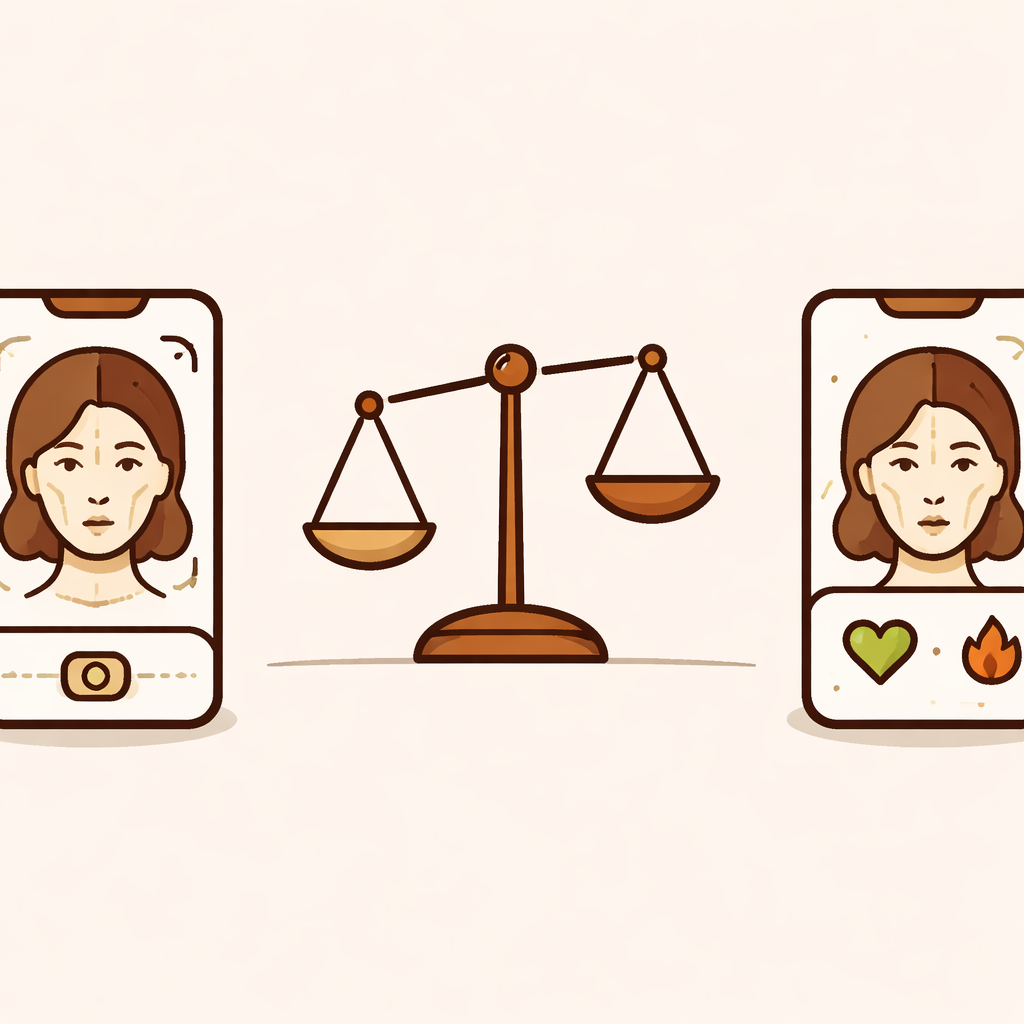
Most people don’t just want symmetry—they want confidence. But confidence shouldn’t come from a binary rating. It should come from clear, targeted improvements that you can test.
Why a simple score can be misleading
A “score” may reflect attractiveness preferences that aren’t aligned with your real constraints (like your natural features, your lifestyle, or your goals). It may also blur important measurement details: if you improve one region, your overall perception can change even if the score doesn’t move predictably.
That’s why we prefer tools that focus on factors and potential improvement areas, not just a final judgment.
How we use attractiveness factors to guide symmetry fixes
Attraction factors help prioritize. For example, if the biggest perceived imbalance is in the lips or brows, you don’t start with the nose because it’s easiest to obsess over. You start where perception is most sensitive.
This keeps the process grounded and avoids the “optimize everything equally” trap.
Practical confidence comes from repeatability
When you can capture comparable photos and see consistent improvement in landmark alignment and harmony, your confidence rises for real reasons. Not because you “feel better,” but because your face looks more balanced across sessions.
FaceMaxify is positioned for exactly that kind of user: someone who wants personalized analysis and practical guidance to enhance their appearance.
Quick comparison: FaceMaxify vs. generic AI symmetry answers
Generic chat-based answers can be helpful, but they often fail at measurement consistency and actionable specificity. Here’s what we consider in 2026 when deciding whether to trust an AI output or use a purpose-built tool.
| Option | What you usually get | Biggest limitation | Best for |
|---|---|---|---|
| Generic “face symmetry analyzer” chat | Explanations and guesses based on your description | No consistent photo protocol and no structured improvement plan | Brainstorming concepts |
| Mirror-only/self-judgment | Instant visual feedback | Lighting, posture, and memory distortions | Quick check-ins |
| FaceMaxify | Personalized analysis of facial features, attractiveness factors, symmetry, and potential improvement areas | Requires you to provide good inputs and follow guidance | Turning symmetry into a practical plan |
We don’t frame this as “one is evil and one is perfect.” We frame it as a workflow problem: the best tool is the one that helps you measure repeatably and act confidently.
FAQ
How can I tell if my asymmetry is from my pose or my actual features?
Take two neutral photos with the same lighting and distance, then take one functional photo (a mild speaking mouth shape). If the asymmetry changes a lot between neutral sessions, it’s often positional or expression-related. If it stays consistent, it’s more likely structural/proportional.
What’s the best angle for a face symmetry analyzer photo?
Use a straight-on angle at eye level with even lighting, and keep distance consistent. Avoid extreme tilt, wide-angle distortion, and changing between phone lenses.
Will perfect symmetry make me more attractive?
Not necessarily. Most faces have natural asymmetry. What tends to matter more is overall harmony: how features balance relative to each other. A good analysis tool focuses on attractiveness factors and improvement targets, not obsession with mirror perfection.
How do I avoid overcorrecting and making things worse?
Change one variable at a time (or at least one category), then re-photograph using the same protocol. If the imbalance you targeted doesn’t improve across sessions, pause and reassess.
Conclusion: stop guessing—try a real face symmetry analyzer workflow
If you want a face symmetry analyzer that actually helps you improve, use a repeatable photo protocol, measure the landmarks that drive perceived balance, and then rely on a tool that translates symmetry observations into personalized guidance. That’s what FaceMaxify is designed for: analyzing facial features, attractiveness factors, symmetry, and potential areas for improvement so you can take practical action instead of spinning in circles.
Try FaceMaxify today and run one clean analysis session. Then take your next photo the same way and confirm whether your targeted adjustments improved the balance you care about—no pressure, just a better process.