AI Face Analysis: What a Face Analyzer Actually Measures
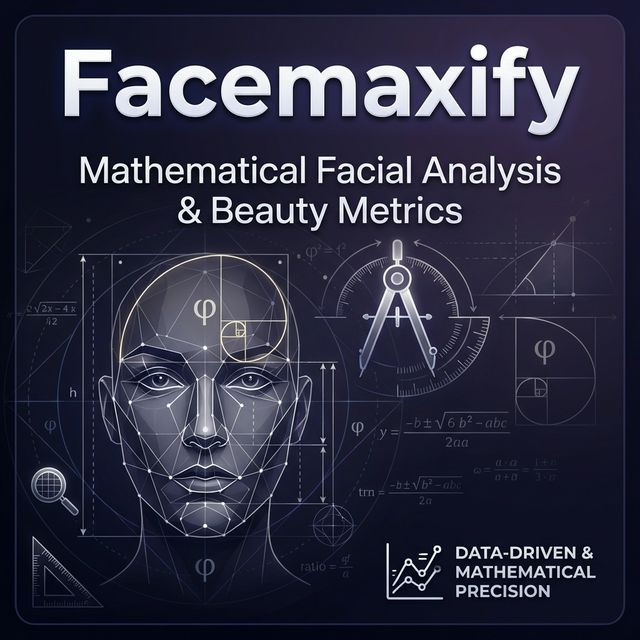
AI face analysis uses computer vision to map points on your face from a photo, then measures how your features relate to each other — symmetry, proportions, eye shape, jawline and overall balance — to explain how your face may come across in pictures. A good face analysis test isn't a verdict on your worth. It's a structured way to understand the visual cues that tend to shape how faces are perceived, so you can make better choices about photos, grooming and style.
This guide explains what a face analyzer actually measures, how it turns a photo into a score, how to read your results without overthinking them, and which free Facemaxify tools you can use to try each kind of analysis yourself.
What does AI face analysis actually measure?
Facial analysis measures the relationships between your features in a clear, front-facing photo. Instead of asking whether someone is "good-looking", a facial analyzer breaks the face into points, distances, angles and ratios, then turns those into a report or score.
Every tool starts by finding facial landmarks — the corners of your eyes, the bridge and base of your nose, your lip line, jaw angles, cheekbones and chin. Facemaxify uses Google's MediaPipe face landmark model, which places 478 points on the face. From those points, a face analyzer can measure:
- Symmetry — how closely the left and right sides of your face mirror each other. Try the face symmetry test.
- Facial thirds — whether your forehead, midface and lower face are roughly equal in height. Try the facial thirds calculator.
- Golden ratio proportions — how certain widths and heights compare with the 1.618 ratio. Try the golden ratio face calculator.
- Canthal tilt — the angle between the inner and outer corners of your eyes. Try the canthal tilt calculator.
- Jawline definition — how your jaw width compares with your cheekbones. Try the jawline score.
- Midface ratio — how long your midface is compared with your lower face. Try the midface ratio calculator.
- Eye spacing — the gap between your eyes compared with eye width. Try the eye spacing calculator.
- Feature harmony — how all of these work together. Try the facial harmony score.
Some analyzers also look at skin — texture, tone and visible concerns. That's a different kind of analysis from facial geometry: it depends heavily on lighting and camera quality, so it's best treated as guidance rather than a score. On Facemaxify, the free tools above measure geometry only; the full analysis adds a separate AI skin report with your likely skin type and a suggested routine.
Why does a breakdown matter? Because attractiveness is usually perceived as a whole-face impression. A single "perfect" feature rarely decides it. Someone with average symmetry can still have a very harmonious face, expressive eyes or a hairstyle that suits their face shape perfectly. A useful facial analysis tool shows you the components, not just one number.
How does an AI face analyzer turn a photo into a score?
A face analyzer AI follows the same basic steps: detect the face, place landmarks, calculate measurements, compare them with reference values, and report the result. The quality of the result depends on two things — the photo, and the method behind the score.
There are two broad approaches:
- Geometry-based scoring. The tool compares your measurements with known reference proportions — for example, a jaw about three-quarters as wide as the cheekbones, or eyes about one eye-width apart. Every point in your score can be traced back to a measurement. This is how Facemaxify's tools work: each one shows the ratios behind your result and the target it's compared against.
- Models trained on ratings. Some AI face rating tools are trained on large sets of photos that people have rated for attractiveness, and learn to predict a rating for a new face. They can capture things geometry misses, but they're a black box — you get a number without a reason — and they inherit the tastes and biases of whoever did the rating.
Whichever approach a tool uses, the score is only as meaningful as its method. If a tool can't tell you why you got your score, treat the number with extra caution.
What do face analysis scores mean?
Scores come on different scales, and they're not interchangeable:
- 0–100 scores, like Facemaxify's attractiveness test or facial harmony score, show how close your measurements are to their targets.
- 1–10 ratings, like the face rating tool, are what most people mean by a "beauty scale 1–10 test" — divide a 0–100 score by ten to compare.
- PSL ratings come from looksmaxxing communities and are deliberately harsh: 5 is the average face, and 7 or more is rare. Try the PSL rating tool if you want that scale.
A score is useful feedback, not identity. It might show that your camera angle makes your jawline look softer, or that your eye area is your strongest feature. It can't measure charisma, warmth, style, confidence or how you come across in person — and those matter enormously.
It also helps to know that "objective" only goes so far. The measurements themselves are repeatable: the same photo produces the same landmarks and ratios. The interpretation is less absolute. Beauty standards vary between cultures and people, and a target proportion is a guide, not a rule.
How should you prepare for a face analysis test?
A face analysis test works best with a clean, direct, realistic photo. Because the tool measures geometry, a poor photo can distort your result far more than most people expect.
- Face the camera directly. A slightly turned head makes one side of your face look narrower, which lowers symmetry scores.
- Keep your head level. Tilting your chin up or down changes every vertical proportion.
- Stand back from the camera. A 2018 study in JAMA Facial Plastic Surgery found that selfies taken about 30 cm from the face make the nose look around 30% wider than photos taken from 1.5 m away. Use the rear camera from arm's length or further.
- Use soft, even front lighting. Harsh overhead or side light creates shadows that move jaw and cheek landmarks.
- Keep a neutral expression. Smiling, squinting or raising your brows shifts landmark positions.
- Skip filters and edits. Beauty filters smooth skin, enlarge eyes and reshape the jaw — the tool ends up analysing the filter.
- Pull your hair back so your forehead, brows and jawline are visible.
- Compare like with like. If you're tracking progress, use the same angle, lighting and distance each time.
A beauty test by photo is really a snapshot of how that photo performs. A low-angle selfie under overhead lighting can score noticeably worse than a well-taken portrait of the same face.
Which facial features matter most for attractiveness?
Decades of research point to a few consistent patterns:
- People agree more than you'd think. A large meta-analysis by Judith Langlois and colleagues (2000) found strong agreement between raters about which faces are attractive, both within and across cultures. That's why measuring faces makes sense at all.
- Averageness is attractive. In a classic study, Langlois and Roggman (1990) blended many faces into digital composites and found the composites were rated more attractive than most of the individual faces. Proportions close to the population average tend to read as healthy and harmonious.
- Symmetry helps, but modestly. People prefer more symmetrical versions of the same face, as Gillian Rhodes's (2006) review of the research describes — but every face is a little asymmetrical, and perfect symmetry can look artificial.
- The golden ratio is overrated. When Pallett, Link and Lee (2010) systematically adjusted the same faces, the most attractive versions had an eye-to-mouth distance of about 36% of face length and an interpupillary distance of about 46% of face width — close to the average face, not the 1.618 ratio.
The practical takeaway: balance across the whole face matters more than any single "ideal" measurement.
How can you turn your face analysis results into real improvements?
A face analysis is most valuable when it points you toward changes you can actually make. Look for patterns across several good photos rather than reacting to one score.
- Low symmetry score? Check your camera angle, posture and distance before assuming it's your face.
- Weak jawline in photos? Lower body fat makes the biggest difference. Posture helps too — a forward head softens the jaw. A well-shaped beard can add definition. See the jawline score guide.
- Unbalanced facial thirds? Hairstyles, fringes and beard length can visually rebalance face length. The face shape detector suggests haircuts for your shape.
- Mixed eye-area feedback? Brow grooming, sleep and reducing puffiness change how the eye area looks. The hunter eyes test explains what makes the eye area read as sharp or soft.
- Skin holding you back in photos? Daily sunscreen, a consistent routine and better lighting will help far more than filters.
- Different tools disagree? Compare the breakdowns, not just the numbers — each tool weights features differently.
Make one or two changes at a time, retake your photos under the same conditions, and compare. That way you'll know what actually helped.
What are the common mistakes when reading AI face analysis results?
- Treating the score like a ranking. A private face analysis is educational. Turning it into a competition makes it less useful and more stressful.
- Assuming "average" means unattractive. On any scale, the middle is normal by design. Plenty of people who are very attractive in real life score in the middle range.
- Chasing every metric at once. Change too many things together and you won't know what worked.
- Ignoring the photo. Lighting, lens distance and expression move scores more than most people realise.
- Taking it too seriously. If a score leaves you feeling worse rather than informed, step away from it. If you find yourself constantly checking, avoiding people or fixating on features others wouldn't notice, talk to someone you trust or a professional — body dysmorphia is common and treatable.
How does Facemaxify's face analyzer work?
Facemaxify offers more than 20 free face analysis tools, each focused on one part of the face — from the attractiveness test and face rating to specific ratios like philtrum length and fWHR. You can browse them all in the free tools directory.
- Private by design. The free tools run in your browser — your photo is analysed on your device and isn't uploaded.
- Transparent scores. Every result shows the measurements behind it and the target each one is compared with.
- Specific, not generic. Each tool explains what its measurement means and what you can realistically change.
For a complete picture, the full Facemaxify facial analysis combines 25+ facial ratios into one report, and adds an AI skin report, personal color and hairstyle analysis, and an improvement plan.
Frequently asked questions
What is AI face analysis?
AI face analysis uses computer vision to place landmarks on your face from a photo and measure features like symmetry, facial thirds, canthal tilt, jawline and proportions. It turns those measurements into a score or report that explains how your face may be perceived.
How accurate is an AI face analyzer?
The measurements are consistent — the same photo gives the same landmarks and ratios. Accuracy depends mostly on the photo: angle, lighting, lens distance and expression all change the result. The interpretation is a guide rather than a fact, because beauty standards vary.
Can AI rate my face attractiveness?
Yes. Tools like Facemaxify's attractiveness test and face rating score your face from a photo. They measure facial structure, not skin, style or personality, so treat the score as one piece of feedback.
Is there a free face analysis test?
Yes. All of Facemaxify's face analysis tools are free, need no signup and run in your browser.
What is a good score on a beauty scale 1–10 test?
On Facemaxify's 1–10 face rating, 6.3–7.5 is attractive, 7.6–8.7 is very attractive and 8.8 or above is exceptional. On the harsher PSL scale used in looksmaxxing, 5 is average and 6 is already a good score.
Why do different face analyzers give me different scores?
Each tool measures different features and weights them differently, and some use trained models instead of measurements. Photo differences also matter. Compare the breakdowns rather than the headline numbers.
Does AI face analysis work for everyone?
The landmark model works on faces of all ethnicities and genders. But most scoring targets are general proportions, and typical facial proportions vary between populations, so a face can be very attractive while sitting further from a target. Read your results with that in mind.
Is my photo safe?
With Facemaxify's free tools, yes — your photo is analysed in your browser and isn't uploaded to a server.
Sources
- Langlois, J. H., & Roggman, L. A. (1990). Attractive faces are only average. Psychological Science.
- Langlois, J. H., Kalakanis, L., Rubenstein, A. J., et al. (2000). Maxims or myths of beauty? A meta-analytic and theoretical review. Psychological Bulletin.
- Rhodes, G. (2006). The evolutionary psychology of facial beauty. Annual Review of Psychology.
- Pallett, P. M., Link, S., & Lee, K. (2010). New "golden" ratios for facial beauty. Vision Research.
- Ward, B., Ward, M., Fried, O., et al. (2018). Nasal distortion in short-distance photographs: the selfie effect. JAMA Facial Plastic Surgery.
- Google. MediaPipe Face Landmarker.